In modern interior design, wall materials are no longer limited to mere decoration; some materials also play a vital role in environmental adaptability and functionality.
In daily consultations, clients frequently ask: What is the difference between WPC panels and acoustic panels? Can they be substituted for each other?
To better address these concerns, we compared the material composition, core functions, and application scenarios of the two materials, aiming to help designers, construction workers, and home renovation enthusiasts make more accurate judgments when making their choices.
What are WPC panels?
WPC panels are a type of board material mainly composed of fiber materials, PVC resin, and additives. They combine the appearance of wood grain with the durability of plastic. They are a more practical material than wood wall panels.
Product Features
In my opinion, the greatest appeal of WPC panels lies in their perfect blend of aesthetics and practicality.
They are waterproof, moisture-proof, deformation-resistant, insect-proof, and possess excellent flame-retardant properties, making them suitable for long-term use in kitchens, commercial spaces, and even semi-outdoor environments.
For projects prioritizing long-term investment returns, WPC panels are not merely a fleeting decorative element, but a more worry-free and durable wall solution.
Applicable Scenarios
From an application perspective, WPC panels are a very versatile material. They are suitable for living room feature walls, entryway accent walls, and special wall designs, quickly establishing a spatial style; they are also frequently used in ceiling and wall panel systems to unify the visual language.
Furthermore, thanks to their stable structure and weather-resistant properties, WPC panel is also widely used in exterior wall cladding and furniture surface decoration, extending design from the interior to the exterior facades.

What are Acoustic Panels?
As the name suggests, sound-absorbing panels are primarily a type of functional building material. They not only enhance the aesthetics of a space but also reduce noise.
Sound-absorbing panels typically employ a porous structure or a special acoustic design to absorb sound waves in a space, thereby reducing echoes and noise accumulation and achieving a noise reduction effect.
Material Composition
The acoustic panels we see are not a single material structure, but a combination of multiple materials designed around the goal of "absorbing sound."
Mineral wool and fiberglass are responsible for efficiently capturing sound wave energy, and polyester fiber enhances safety and stability. At the same time, open-pore wood or veneer structures ensure acoustic performance while providing a more aesthetically pleasing look to the space.
This type of panel allows multiple materials to work synergistically, simultaneously achieving effectiveness on both acoustic and aesthetic levels.
How do acoustic panels work?
Acoustic panels don't so much reflect sound as they "absorb" it. When external sound waves enter the porous structure and the cavity behind the panel, they rub and collide within countless tiny channels, converting sound energy into heat energy, which is then slowly dissipated.
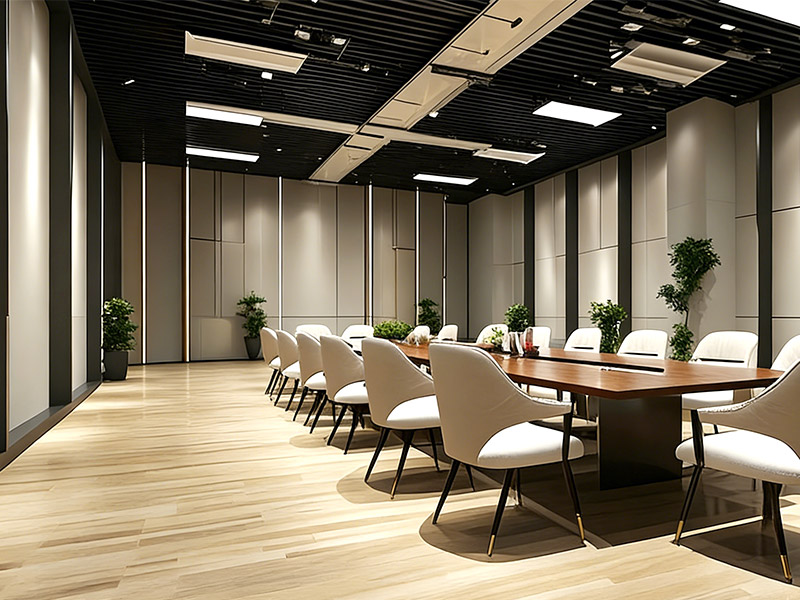
The difference between WPC Panel and Acoustic Panel
| Comparison Items | WPC Panel | Acoustic Panel |
| Materials and Structure | It is made of fiber materials, PVC resin, and additives. It is available in both hollow and solid structures. | With mineral wool, glass fiber, polyester fiber, or an open-cell substrate as the core, it falls under the category of function-oriented acoustic structures. |
| Functional Differences | It focuses more on decoration. As a substitute for traditional wood materials, it solves the problems of poor moisture resistance and durability. | It combines functionality and aesthetics. Its core function is to absorb sound waves and mitigate the impact of noise. |
| Acoustic Performance | It lacks professional sound absorption capabilities and is more of a reflective surface. | With a defined sound absorption coefficient, it can significantly reduce reverberation and noise. |
| Decoration and Aesthetics | Emphasis is placed on texture and appearance, such as wood grain, stone grain, and custom finishes, with a focus on overall space decoration. | More focused on functional aesthetics, it combines acoustics and design through openings, fabrics, and wood veneers. |
| Installation and Maintenance | It features a convenient installation system, typically using adhesive for installation. Furthermore, it has low maintenance costs. | It typically needs to be arranged according to an acoustic scheme. Local replacement is convenient, and the surface needs to be protected against dust and dirt. |
| Cost | Compared to solid wood or metal materials, WPC materials offer controllable costs, making them suitable for large-scale or commercial projects. | Its price is related to its acoustic rating, but overall, it will be more expensive than WPC wall panels. |
How do you choose between WPC Panel and Acoustic Panel?
If your project prioritizes the overall decorative effect, durability, moisture resistance, and long-term maintenance costs of the walls, then WPC boards are more of a "basic solution." They are suitable for large-area applications to establish spatial style, unify facade language, and meet the wear and stability requirements of daily use.
As spaces demand increasingly higher sound quality—for example, addressing issues like noticeable echoes, unclear dialogue, and noise interference with work efficiency—acoustic panels cease to be merely an option and become a functional configuration.
Conference rooms, cinemas, training venues, live streaming studios, and educational and medical environments all require meticulously designed acoustic environments, not just decorative wall coverings.
In many successful projects, the two are not contradictory but rather complementary: WPC is responsible for the overall decoration and structural design of the space, while the acoustic panels are responsible for acoustic control in key areas. Choosing the right combination often makes a greater difference in the professionalism of a project than choosing a single material.
| Application Cases | Recommended Materials | Recommendation Reason |
| Living room/Bedroom | WPC panels, or use them in combination. | Living rooms and bedrooms emphasize decoration and style. Therefore, WPC panels may be the preferred material. |
| TV background wall / Feature wall | WPC panels | Emphasis is placed on visual appeal, design, and ease of cleaning. |
| Kitchen / Damp Area | WPC panels | Waterproof and moisture-proof, not easily deformed, easy to clean, and with a low maintenance cost. |
| Office Common Areas | The WPC panel and acoustic panel are used in combination | The WPC panel was responsible for the overall facade, and acoustic panels were used to reduce noise interference in the open office area. |
| Meeting Room / Boardroom | The main component is sound-absorbing panels, supplemented by decorative finishes. | Emphasis is placed on noise reduction to create a quiet space for business negotiations. |
| Cinema / Live Streaming Room / Multimedia Room | Acoustic Panel | High-grade acoustic noise reduction materials are needed to achieve a good viewing experience. |
| School Classrooms/Training Centers | Sound-absorbing panels + durable wall system | Improves reverberation and enhances listening efficiency, while also ensuring durability. |
| Hotel Lobby / Commercial Space | WPC boards are the primary material, with sound-absorbing panels added in key areas. | WPC panels are used to shape the texture of a space and emphasize style, while sound-absorbing panels are used to reduce noise in the reception and rest areas. |
| Restaurant / Cafe Shop | Combined use | Commercial spaces that also emphasize aesthetics and noise reduction. |
| Showroom / Brand Space | WPC Panel | More emphasis is placed on visual expression, modeling ability, and long-term maintenance costs. |
Conclusion
Therefore, it's clear that WPC boards and acoustic panels fundamentally address two completely different problems.
WPC boards are structural and decorative materials, responsible for the appearance, durability, and overall finish of a space; acoustic panels, on the other hand, are typical acoustic control materials, serving clarity, comfort, and user experience.
When faced with a difficult choice, the key shouldn't be simply comparing "which is better," but rather determining what problem the project needs to solve and matching that problem with the appropriate material system.
FAQS
Q1: What are WPC panels?
A1: WPC panel is a composite wall covering system. It is made of fiber materials, PVC resin, and additives. It can be molded to resemble wood grain, marble, and other finishes and offers advantages such as water resistance, durability, and low maintenance.
Q2:What are acoustic panels?
A2: Acoustic panels are materials that use porous or fibrous core materials (such as foam, fiberglass, or mineral wool) to absorb sound and control reverberation.
Q3:Can WPC panels improve acoustics?
A3: WPC panels were designed with a focus on aesthetics in mind, and because they lack sound-absorbing materials, they are not a professional acoustic solution.
Q4:What materials are acoustic panels made of?
A4: Acoustic panels typically use materials such as foam, polyester fiber, fiberglass, mineral wool, or perforated wood structures to absorb and dissipate sound.
Q5:Where are acoustic panels typically used?
A5: Offices, meeting rooms, classrooms, theaters, recording studios, restaurants, and any place where echo control and improved speech intelligibility are required.
Q6: Are WPC panels waterproof?
A6: It is waterproof, moisture-proof, and flame-retardant. Therefore, it is suitable for both dry indoor areas (living room, bedroom, hallway, and ceiling) and damp areas (bathroom, kitchen, and basement).
Q7: Do acoustic panels absorb all frequencies?
A7: No, most sound-absorbing panels are effective for mid-to-high frequency sounds. Low-frequency sound control may require thicker sound-absorbing panels or special sound-absorbing treatments.
Q8: Can acoustic panels be decorative?
A8: Yes. Modern acoustic panels come in a variety of colors, shapes, and textures, and can also be used as an interior design element.
Q9: Are WPC acoustic panels a thing?
A9: Yes. Some WPC variants combine decorative wall cladding with improved acoustic performance, though pure acoustic panels still outperform them in echo control.
Q10: How long do acoustic panels last?
A10: The lifespan of sound-absorbing panels is not fixed and is affected by various factors. Common lifespans for sound-absorbing panels are as follows:
Polyester fiber acoustic panels: 15-20 years.
Fiberglass acoustic panels: Approximately 5-10 years.
Rock wool acoustic panels: Generally 8-12 years.
Foam acoustic panels: Approximately 3-8 years.
Aluminum honeycomb perforated acoustic panels: Typically over 15 years.
Q11: What installation methods are used for acoustic panels?
A11: Depending on the material type and design, sound-absorbing panels can be installed using clips, adhesives, tracks, or hanging frames.
Q12: Are acoustic panels easy to clean?
A12: Hard or fabric-covered sound-absorbing panels may require light vacuuming or surface cleaning, while porous core materials require careful dust control.
Q13: Do acoustic panels help with privacy?
A13: Yes. By absorbing sound energy, they reduce sound leakage and improve privacy between spaces.
Q14: Are WPC panels eco-friendly?
A14: CREATEKING's WPC panels are made from environmentally friendly materials, reducing reliance on natural wood and contributing to environmental protection.
Q15: Do WPC panels require special installation tools?
A15: CREATEKING's WPC wall panels feature a convenient installation system. The panels are joined using a mortise and tenon joint, creating a seamless finish. They can then be easily attached to the wall using strong adhesive.