In many flooring installation projects, people often focus on color, texture, and material selection, neglecting an equally crucial detail—the transition between floorboards.
In fact, while seemingly insignificant, floor transition strips play a vital role in the entire flooring system. They not only protect floor edges and conceal expansion joints but also create a more natural transition between different spaces, enhancing the overall design's integrity and safety.
Because the structure and usage requirements of each location differ, there is no single transition strip suitable for all scenarios.
Therefore, understanding which type of transition strip to use in which location is key to achieving professional flooring installation. Next, we will introduce the most suitable transition solutions for common flooring connection locations in actual renovations.
Between floors of the same height
When two floorboards of the same height meet in a space, they may seem like they can be directly joined together. However, in actual installation, a certain expansion joint is still needed to accommodate the expansion and contraction caused by changes in temperature and humidity.
This is where transition strips become particularly important. They not only cleverly conceal the gap between the two floorboards but also protect the edges from wear and tear, while making the transition between different areas look more natural and neat.
Best Choice: T-Molding and U-Channel Transition Strips
Transition strip materials: Aluminum alloy, stainless steel, PVC, SPC
Examples: Between SPC flooring, between laminate flooring, between hardwood flooring, between vinyl flooring

Between floors of different heights
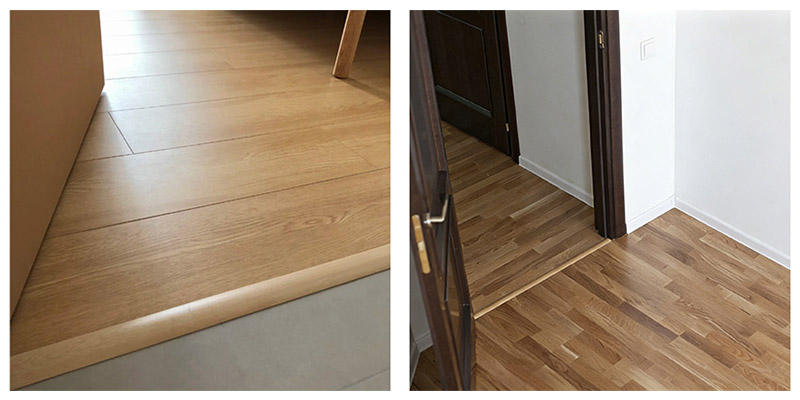
When two different floor heights meet in the same space, the problem is often not just visual disharmony, but also a real "step" underfoot.
Without a proper transition, this height difference can make the space feel jarring and may even pose a tripping hazard.
This is why a reducer transition strip with a sloped design becomes a very practical solution. It creates a natural transition between floor levels, allowing footsteps to move smoothly from one type of flooring to another while protecting the edges of the higher flooring from warping or damage from prolonged use.
Simply put, it visually "smooths out" the height difference and also makes the space safer and more comfortable to use.
Best Choice: Reducer Transition Strips
Transition strip materials: aluminum alloy, stainless steel, PVC, SPC
Examples: the transition from SPC floor to tile, the transition from laminate to carpet pad, and the transition from hardwood to concrete floor.

Transition between Floor and Wall
Where the floor meets the wall, what may seem like a simple edge actually requires an expansion joint during installation to prevent the floor from expanding or contracting due to temperature and humidity changes.
If these gaps are directly exposed, they not only affect the overall aesthetics but also easily accumulate dust and moisture, potentially even damaging the floor edges.
This is where transitional solutions like baseboards, quarter-circle edge trims, or L-shaped floor edge trims become crucial. They cleverly conceal the expansion joints, creating a cleaner, more streamlined wall edge, while also providing a layer of protection for the floor edges.
In other words, these seemingly understated edge details are often key to making a space look more complete and professional.
Best Choice: Baseboards, Quarter Round, or L-Shape Trim
Transition strip materials: aluminum alloy, stainless steel, PVC, SPC, MDF

Between the Floor and Floor-to-Ceiling Windows
In many modern spaces, floor-to-ceiling windows often mean a more expansive view, but they also bring up a small, easily overlooked detail – how to finish the floor edges.
Unlike ordinary walls, there's usually no place to install baseboards under floor-to-ceiling windows, but the floor still needs to allow for expansion and contraction. If the edges are directly exposed, it not only looks slightly rough, but over time, it may warp or wear due to foot traffic, cleaning, or temperature changes.
This is where a simple L-Shape Edge Trim comes in, like drawing a clean "border" for the floor. It firmly holds the floor edges in place, hides expansion joints, and makes the transition between the floor and the glass appear natural and smooth, making the entire window area look more complete and refined.
Best Choice: L-Shape Edge Trim
Materials: Aluminum alloy, stainless steel, PVC

Between Carpet and Hard Floor
The transition between carpet and hard flooring is often not just a matter of material change, but also a direct clash between "soft" and "hard."
Without a proper edge finishing solution, carpet edges can easily loosen and curl, while the hard floor side may show wear and tear from prolonged foot traffic, even creating an unnatural unevenness.
This is where Carpet Transition Strips (especially those with hooks and loops) come in. They firmly secure the carpet edges while creating a smooth transition between the two materials, making the transition from soft to hard more natural and stable underfoot.
In other words, they not only connect the two flooring materials but also balance the relationship between feel, structure, and user experience.
Best Choice: Carpet Transition Strips
Materials: Aluminum alloy, stainless steel, PVC

Transition between Living Room and Bedroom
Imagine stepping out of the living room and gently into the bedroom—the transition strip under your feet has quietly performed its magic.
Door thresholds, T-Molding, or universal clips between the living room and bedroom are more than just aesthetically pleasing "boundaries." They cleverly solve problems related to floor level differences, prevent wear and tear and dust accumulation, create a smooth and natural transition between spaces, ensure comfortable walking, and add a touch of refined finishing touch.
Best Choice: Door Thresholds or T-Molding
Materials: Aluminum alloy, stainless steel, PVC, solid wood

Threshold Strip at the Entrance
The threshold transition strip at a house entrance is the subtle hero of first impressions. It smooths out floor height differences, protects surfaces from wear, keeps out dust and moisture, and adds a polished, seamless touch—making every step inside feel effortless and refined.
Best Choice: Threshold Strips or Universal Transition Strips
Material: Aluminum alloy, stainless steel, PVC
Stair Tread Edge Trim
Stair tread edge trims are the subtle charmers of your stairs.
They protect edges from chips and wear, add a touch of slip-resistance, and make each step feel solid underfoot. At the same time, they neatly frame the stairs, turning every ascent and descent into a smooth, polished experience that whispers “careful, but stylish.”
Best Choice: Stair Edge Trim
Material: Aluminum alloy, stainless steel, PVC

How to Choose a Suitable Transition Strip?
1. Floor height difference
Different ground heights? Don't panic. Use T-shaped strips of the same height for a smooth and natural finish; for differences in height, choose a special type that fits the two types of ground like a handshake, ensuring both safety and elegance, making walking much easier.
2. Material compatibility
Transition strips aren't chosen arbitrarily; they need to "get along" with the flooring.
SPC, composite boards, and solid wood each have their own characteristics. Choosing the right material ensures stability and durability, making it fit like a custom-made accessory for the flooring.
3. Traffic flow
Choose styles based on foot traffic: high-frequency areas should be wear-resistant and slip-resistant, while low-frequency areas can be lightweight and aesthetically pleasing. Transition strips are not just boundaries; they are also loyal companions for foot traffic throughout the home.
4. Installation method
The installation method is also crucial. Clips are effortless, adhesive is easy, and screws are secure. Choosing the right method is like finding the right stage for the transition strip—it looks good, works well, and even maintenance is easy.
Conclusion
Transition strips may seem insignificant, but they are the "little magicians" of the flooring world.
They subtly eliminate height differences, prevent wear and tear, and create a natural and pleasing connection between spaces. Choosing the right style makes installation easier and extends the life of your flooring; planning each connection point ensures a smooth and stylish transition in your home.
FAQS
Q1: What exactly are transition strips?
Transition strips are finishing pieces that bridge gaps between two different flooring materials or heights, cover expansion gaps, protect edges, boost safety, and improve appearance.
Q2: When should I use transition strips between rooms?
Use them where two different flooring types meet (e.g., tile to wood, vinyl to carpet) or at doorways where the surface changes.
Q3: Are transition strips necessary if the flooring is the same?
A3: T-shaped or U-shaped transition strips could be considered.
Q4: Do transition strips help with height differences?
A4: Yes. Reducer profiles or threshold strips smooth out changes in floor height, eliminating trip hazards and making crossings safer.
Q5: Should floating floors always have transition strips?
A5: Floating floors like laminate or luxury vinyl plank usually need transition strips to allow expansion and contraction, especially at doorways or long runs.
Q6: Can I skip transition strips for aesthetic reasons?
A6: In open layouts with the same flooring, some choose not to use them for a seamless look — but expansion gaps still need thoughtful planning.
Q7: Where should transition strips be placed?
A7: Between floorboards, under thresholds, at the transition between walls and floors, at the edges of stair treads, at the transition between carpet and floor, at room entrances, etc.
Q8: Do transition strips protect my flooring?
A8: Absolutely — they prevent wear at exposed edges, reduce chipping or fraying, and help floors endure daily traffic.
Q9: Should transition strips be used at exterior openings?
A9: Yes — threshold or end-cap strips are ideal where indoor flooring meets an exterior entry or step to protect edges and seal gaps.
Q10: What if I install floors without strips and problems occur later?
A10: Without proper transitions, floating floors may buckle, seams can open, and edges can wear faster. Transition strips help avoid these long‑term issues.